Safepass: photometric innovation for safer mobility.
The safety of people at crossings and pedestrian crossings remains one of the major challenges in public space planning. In poorly lit environments, the risk of being hit by a pedestrian increases considerably, especially on urban roads with dense traffic or on secondary roads where vehicles travel at higher speeds. The problem lies in something as simple as it is critical: the pedestrian is not seen in time by the driver.
This challenge, common to any city or municipality, has prompted the lighting industry to seek specific solutions to complement conventional street lighting. At Salvi, we wanted to go a step further in this field, developing an optic designed exclusively for crosswalks, Safepass.
Regulations and frame of reference
In Spain, the Regulation on energy efficiency in outdoor lighting installations (RD 1890/2008) includes a specific section on crosswalk lighting. However, its scope is limited: it devotes only a small paragraph to defining the basic requirements.
At the European level, various working groups have focused on this weak point in road safety. Although there is still no mandatory EU regulation, new lighting classes have already been proposed that establish illuminance and uniformity levels according to the type of road. This corrects one of the main problems of the national framework: the strong contrasts between the crosswalk and the roadway, which can confuse the driver instead of facilitating the perception of the pedestrian.
In our project department we have incorporated these guidelines as a design reference, anticipating regulatory developments and ensuring that the solution meets the most demanding safety standards.
An optic designed from the ground up
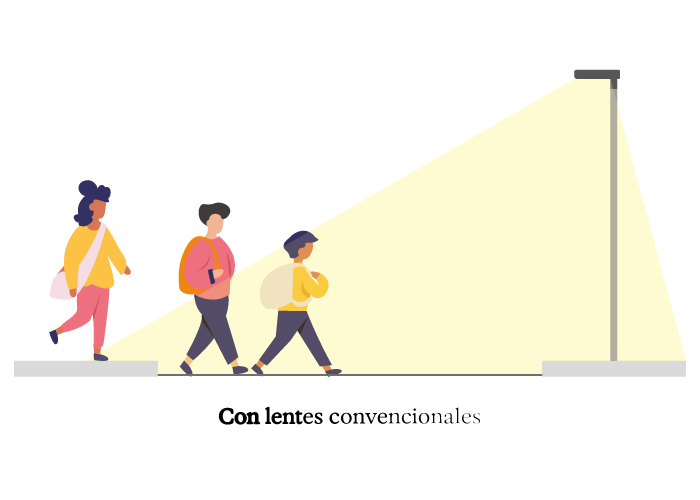
Most of today's lighting systems are based on the adaptation of generic optics to different urban environments. However, in the case of crosswalks, the solution had to be different.
Our Safepass proposal is based on an optic developed specifically for this use, with the aim of increasing pedestrian visibility and avoiding glare for the driver. The key is in the photometric distribution:
- Horizontal plane: ensures minimum illuminance levels and uniformity on the crossing surface.
- Vertical plane: ensures that the full figure of the pedestrian is clearly visible from the vehicle's perspective, regardless of the vehicle's speed.
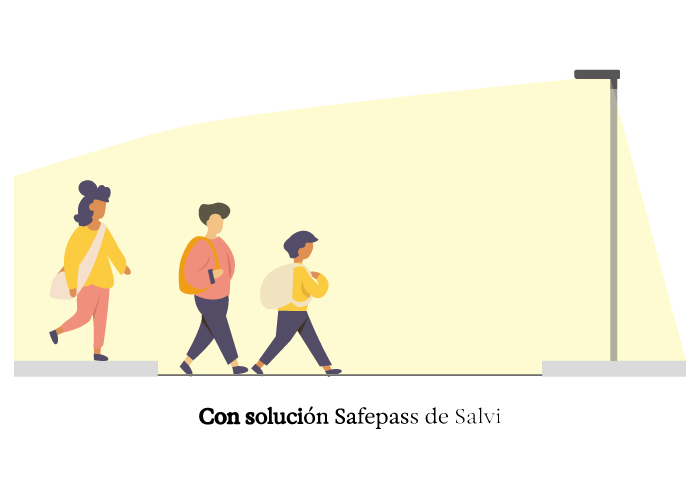
In this way, not only the ground is illuminated, but also the pedestrian's body, allowing faster and more accurate identification.
The uniformity of the whole is achieved thanks to the combination of the new Safepass lens and the strategic arrangement of the light points according to the direction of traffic.
Versatility of application
The solution has been designed with flexibility to adapt to different scenarios:
- Urban areas, with installation heights between 4 and 6 meters.
- Roads, with heights of up to 10 meters.
This makes it ideal for school or residential environments, where pedestrian vulnerability is higher, as well as for fast-moving roads in peri-urban areas.
Energy efficiency and sustainability
Although installation and maintenance do not differ from other conventional solutions, there is a clear benefit in terms of efficiency: the lens directs light exclusively to critical areas - the pedestrian walkway and adjacent sidewalks - avoiding losses in irrelevant areas.
The useful life is equivalent to that of the rest of Salvi's luminaires, which guarantees reliability and sustainability over time. In addition, there is a reduction in light pollution and energy consumption associated with more precise lighting.
Road safety: beyond data
At the moment, no specific statistics are available to measure the impact of this optic on accident reduction. However, the technical logic is clear: by improving the perception of the pedestrian in the vertical plane, the driver has more reaction time and thus reduces the risk of being run over.
This principle, endorsed by European working groups and experience in road lighting projects, makes this solution a strategic ally of municipal road safety policies.
Towards the first implementations
The Safepass solution is currently in the launch phase. The first installation projects are underway and field results will soon be shared. This stage will allow gathering feedback from municipalities, engineering firms and users, an essential step to validate in practice the benefits already observed in the design.
Conclusion
Safe mobility depends not only on road infrastructures or awareness campaigns, but also on technical solutions that reduce the margin of human error. Crosswalk lighting is a good example: a seemingly minor detail that can make the difference between seeing or not seeing a person crossing the street.
With Safepass, Salvi puts technology at the service of public safety, offering municipalities a concrete tool to protect their pedestrians and move towards safer and more sustainable urban environments.